What it is

The slab becomes the radiator

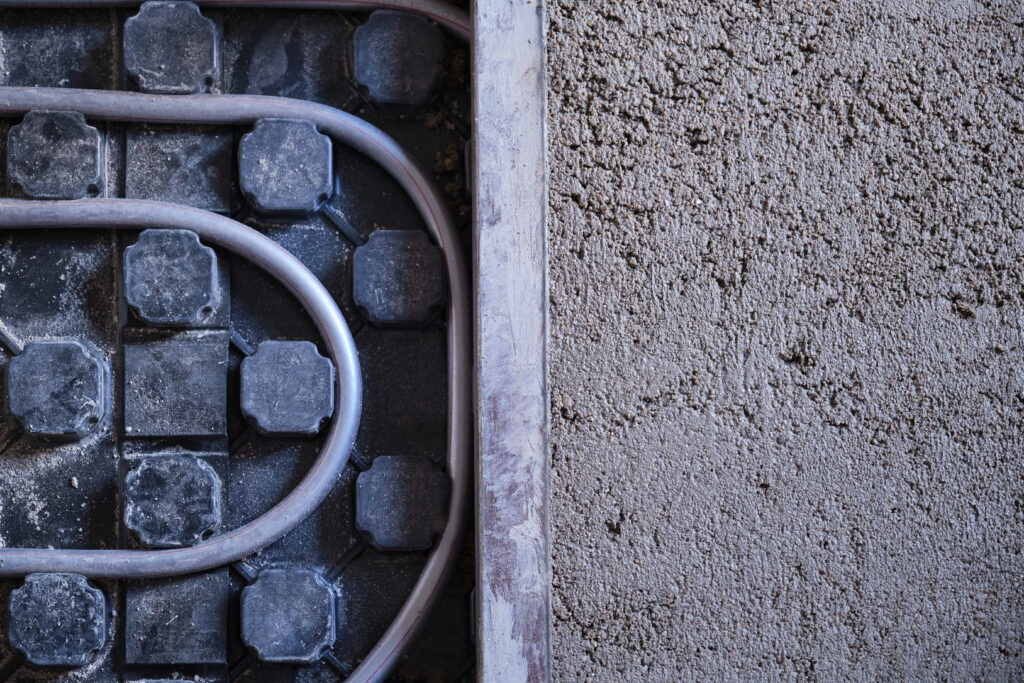
Cable is fixed to the reinforcement and buried in the pour. The concrete holds the heat and gives it back slowly, so the surface you stand on is the heat emitter and there is nothing in the room to work around.

Two jobs, one method. As comfort heating it takes the chill off a floor a hydronic loop would be overkill for. Sized against the heat loss of the space, it is the primary heat source and there is no boiler, no manifold and no second trade.

Which of the two a project needs is a load calculation, not a preference. It depends on the insulation under the slab, the envelope above it, and what the building is for. That calculation is part of the quote, and it is the number an electrician sizes the service against.

The cable is set once and the finished floor goes down on top of it. Everything that decides whether the system performs — watt density, spacing, sensor position, the insulation below — is settled on the drawing, before a reel is opened.

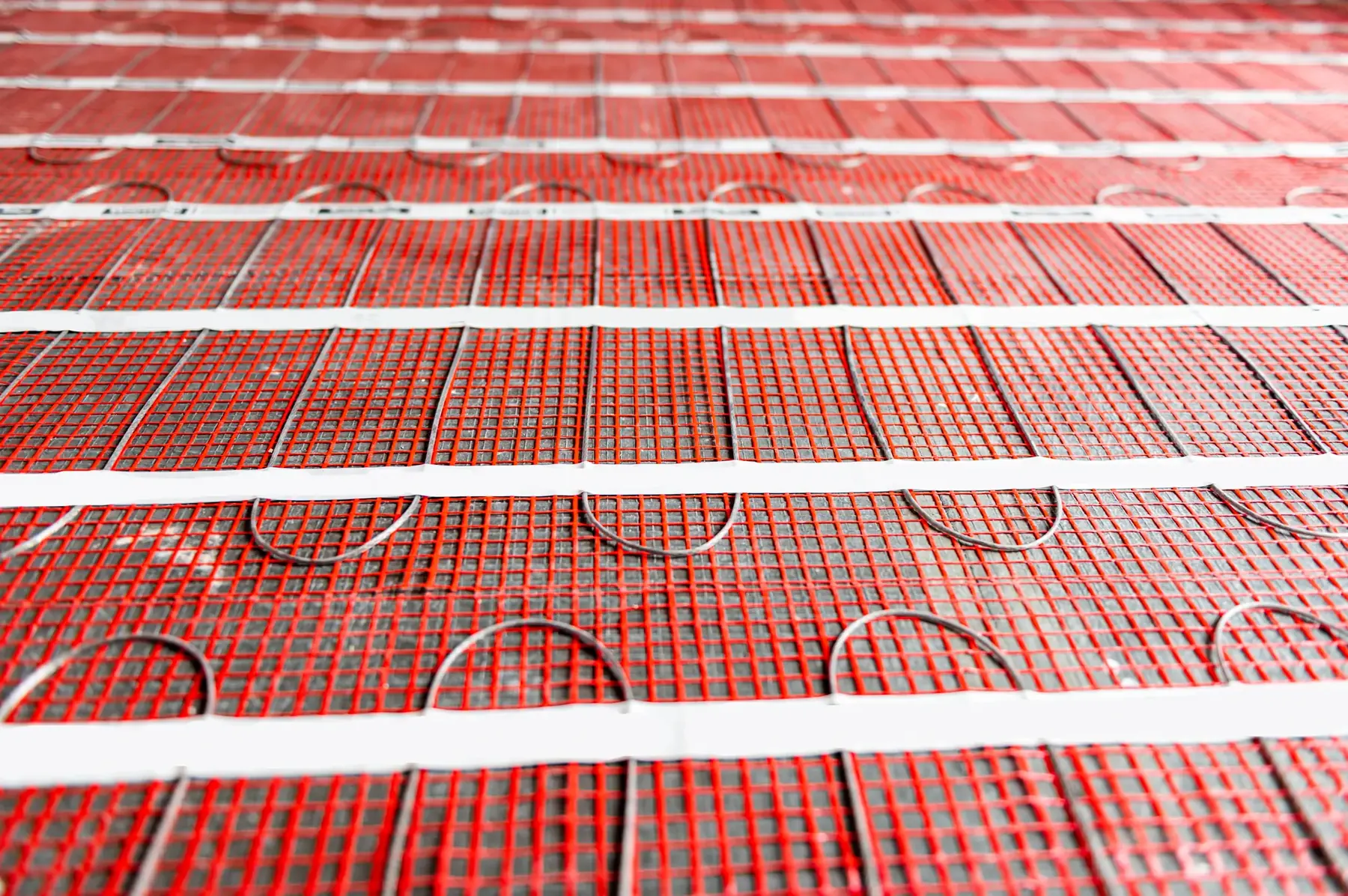
Electric heating mat taped down over a floor, the cable held on a mesh backing in parallel runs before the finish goes on.
Twin-conductor mat on its mesh backing, set out before the pour.
Where it goes

Where a heated slab pays for itself

Named by the space rather than the part code. The Danfoss line behind each one is on the right.

01

Residential floors

Comfort heating under tile, stone and engineered floors. Mat where the layout is regular, loose cable where it is not, run off a thermostat in the room.

Bathrooms, kitchens, entries, basements

Danfoss LX
Mats, cables, thermostats
02

Garages and workshops

A heated slab dries a vehicle out instead of leaving meltwater to freeze on the floor, and holds a working temperature in a space that is opened to the weather several times a day.

Attached garages, shops, service bays

Danfoss LX, TX
Slab on grade
03

Warehouses and light industrial

Primary heat from the floor up, in a building where hanging plant from the roof structure costs more than putting cable in a slab that is being poured anyway.

Warehouses, shops, storage, light manufacturing

Danfoss TX
Thick-cable, TX-FH
04

Off-peak thermal storage

The slab is charged when power is cheapest and gives the heat back through the day. Whether this is worth doing depends entirely on the tariff, and Alberta rate structures are not uniform.

Where a time-of-use rate applies

Danfoss TX-SH
Off-peak charge
Specification

What Danfoss publishes for LX and TX

Manufacturer figures for the LX and TX lines, from the Danfoss catalogue. Values Danfoss publishes only per product are settled on the layout drawing that comes back with the quote.

Output

Watt density
97–194W/m²
Connected load
Per layout

Product

Floor heating
LX
Thick cable
TX-FH
Thermal storage
TX-SH
Controls
LX thermostats

Warranty

Condition
Recorded readings
Terms
Manufacturer
Installation

Set once, tested three times

The system goes in once, under a floor nobody will lift again for decades. The resistance readings are the part a general trade tends to skip, and they are what the warranty file rests on.

Every job starts as a drawing.

Area, watt density, cable spacing, sensor positions and connected load are settled on paper before a reel is opened, because the cable is set once and the floor goes down on top of it. That drawing comes back with the quote.

Dry-Ways supplies the system and can install it. Where another contractor is doing the work, the layout, the load and the test regime are still issued with the order, because the warranty depends on them.

See the full installation sequence

  1. Insulate below the slab

    Heat goes both ways. Without insulation under and at the edges of the slab, a share of the output goes into the ground.

  2. Test on delivery

    Ohm reading taken before anything is unrolled, to prove the cable did not take damage in transit.

  3. Lay out and fix

    Cable tied to the mesh at the spacing the layout drawing calls for, with the floor sensor in a conduit so it can be replaced without breaking concrete.

  4. Test before the pour

    Second reading once everything is fixed and the cold leads are run back to the panel.

  5. Pour, then read it again

    Concrete goes down over the cable. The final reading is the last chance to find a fault, and it is what closes the warranty file.

  6. Commission the controls

    Thermostat and floor sensor set to a slab temperature. A heated slab is slow by design, so it is run to a temperature rather than switched on and off.

Why electric

The plant room you don’t build

Most of the cost and nearly all of the maintenance in a heated slab sits in the plant room, not in the slab. Electric takes the plant room out of the drawing.

Nothing to service

01

No boiler, no pump, no manifold, no fluid. There is no annual service call on a cable buried in concrete, and nothing to bleed or refill.

No added floor height

02

Cable sits in the slab that was being poured anyway. There is no screed to add and no ceiling height to give away.

Room by room

03

Each area runs off its own thermostat and only draws power when that space calls for heat, rather than driving one loop for the whole building.

FAQ

Whole-building heat, existing floors, and warm-up

Five answers specific to in-slab heating. The general questions are on the homepage FAQ.

Not here? Send us the room or call 780-953-9297.

Can it heat the whole building, or only take the chill off?

Either, and the difference is a load calculation rather than a different product. Sized against the heat loss of the space it is the primary heat source. Sized for comfort it warms the surface and something else carries the load. What a given building needs depends on its insulation and its envelope, and that calculation comes with the quote.

Can it go into a floor I already have?

Not into an existing slab. The cable is set in the pour, or in the mortar bed when a tile floor is being taken up and relaid. If the floor is coming up anyway, that is the moment.

Does the floor have to be tile?

Tile and stone conduct best and are the usual finish. Engineered floors are common over a heated slab but the manufacturer of the floor covering sets a maximum surface temperature, and that limit governs.

How long does it take to warm up?

A concrete slab is slow on purpose. That is what makes the heat even, and it is why the system is run to a temperature and left there rather than switched on when a room feels cold.

What does it cost to run?

Unlike snow melting, in-slab heating runs through the season rather than only during a snowfall, so the running cost is a heating bill and not a per-event figure. The running cost panel on the homepage is built for the snow-melting case and does not answer this one.